
What You’ll Learn in This Article: Understanding how altitude affects air compressors is essential when selecting, sizing, or maintaining a compressed air system in Colorado. In this article, you’ll learn why compressor output decreases at higher elevations, how Colorado’s climate further impacts performance, and the practical steps you can take to improve system reliability, efficiency, and long-term performance.
How Altitude Affects Air Compressors Matters in Your Facility
If your compressed air system isn’t delivering the performance you expected, the problem may not be the compressor itself. Equipment that performs well at sea level can lose a significant amount of usable air capacity when installed in Colorado Springs, Pueblo, Woodland Park, or other higher-elevation communities throughout Southern Colorado.
Because manufacturers like Sullair publish compressor performance data under standardized sea-level conditions, systems that appear properly sized on paper may struggle to meet production demands once installed at elevation. The result can be reduced airflow, pressure fluctuations, longer compressor run times, and higher operating costs.
At Remco, we regularly evaluate compressed air systems that appear undersized or inefficient. In many cases, the equipment is operating as designed—the original system simply wasn’t engineered for Colorado’s elevation and operating conditions.
Why Elevation Changes Compressor Performance
Air compressors are typically rated at sea level using standard atmospheric conditions of approximately 14.7 psi, 68°F, and dry air. As elevation increases, atmospheric pressure decreases, meaning each cubic foot of air contains fewer air molecules available for compression.
Although a compressor continues moving nearly the same volume of air, the reduced air density means less usable compressed air is delivered to the system. As a general guideline, compressor output decreases by approximately 3–4% for every 1,000 feet of elevation gain, although actual performance also depends on temperature, humidity, and compressor design.
Understanding how altitude affects air compressors helps facility managers, contractors, and maintenance teams make better decisions when selecting equipment, planning system upgrades, or troubleshooting performance concerns.
Related: 10 Warning Signs Your Air Compressor Needs Service
How Much Does Altitude Affect Air Compressors in Colorado?
Understanding that altitude affects air compressors is one thing—seeing the impact in real-world conditions is another. Colorado’s wide range of elevations, from the eastern plains to mountain communities above 9,000 feet, clearly demonstrates how compressor performance varies with elevation.
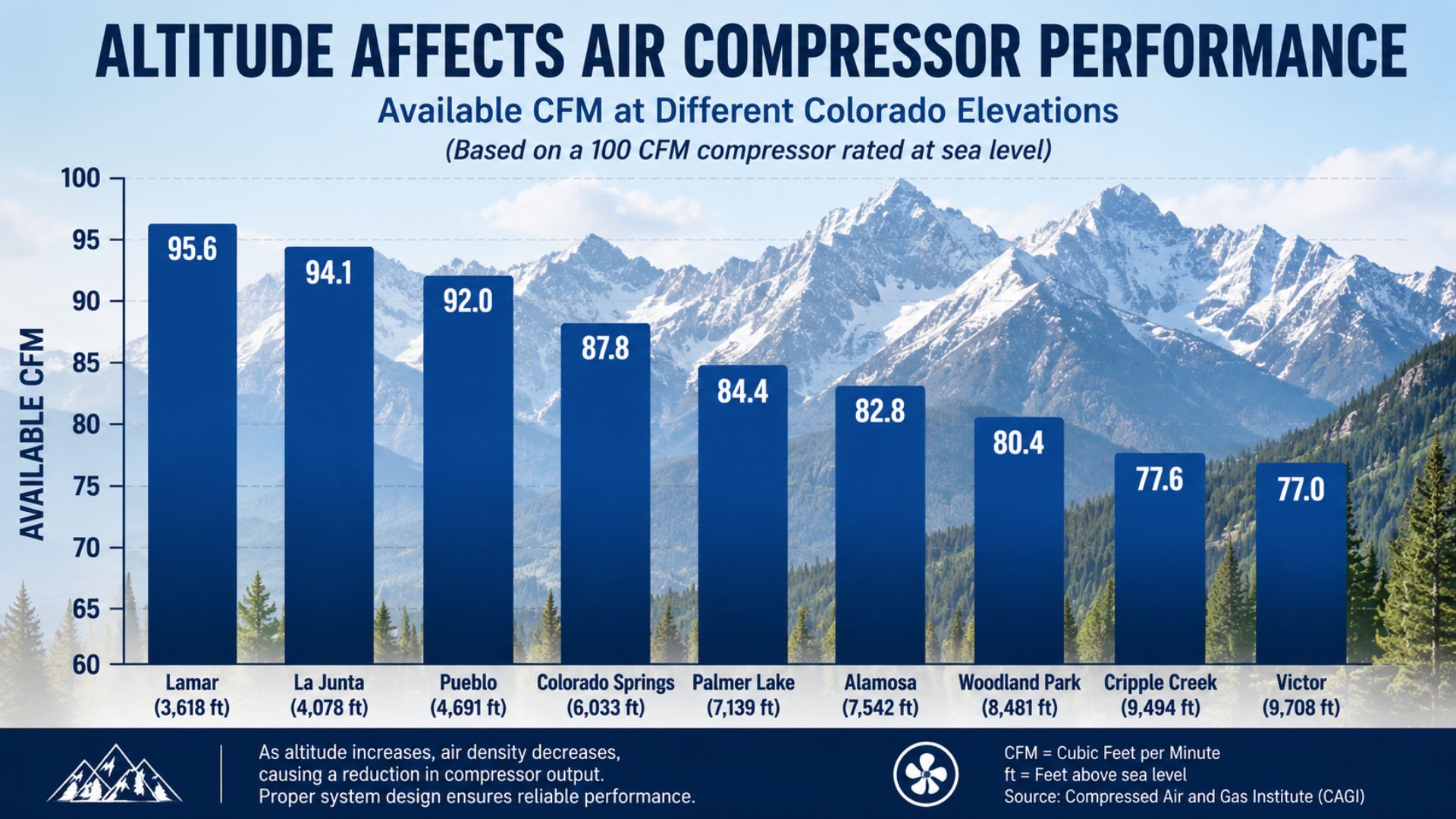
The following examples are based on a compressor rated at 100 CFM under standard sea-level conditions (68°F with dry air). While actual performance varies by manufacturer and compressor design, the data illustrates how usable output declines as atmospheric pressure decreases.
Lower Elevations (Approximately 3,500–4,500 Feet)
Facilities in Colorado’s eastern plains experience the smallest performance losses, though they remain measurable.
- Lamar (3,618 feet): Approximately 95.6 CFM
- La Junta (4,078 feet): Approximately 94.1 CFM
Even these modest reductions can affect applications that require continuous airflow or operate near maximum capacity.
Mid-Elevation Communities (5,000–7,000 Feet)
As elevation increases, output declines more noticeably.
- Pueblo (4,691 feet): Approximately 92.0 CFM
- Colorado Springs (6,033 feet): Approximately 87.8 CFM
- Palmer Lake (7,139 feet): Approximately 84.4 CFM
A facility in Colorado Springs using a compressor rated at 100 CFM at sea level can realistically expect about 88 CFM under standard local conditions, before accounting for temperature and humidity. That reduction alone can increase compressor runtime, cause pressure drops during peak demand, and reduce overall system efficiency.
Higher Elevations (Above 7,500 Feet)
Performance losses become even more significant in Colorado’s mountain communities.
- Alamosa (7,542 feet): Approximately 82.8 CFM
- Woodland Park (8,481 feet): Approximately 80.4 CFM
- Cripple Creek (9,494 feet): Approximately 77.6 CFM
- Victor (9,708 feet): Approximately 77.0 CFM
At nearly 10,000 feet, a compressor rated at 100 CFM at sea level delivers only about 77 CFM—a reduction of nearly 23% before weather conditions are considered.
At Remco, we frequently evaluate systems that appear undersized when compared to published specifications. In many cases, the compressor is operating properly, but the original system wasn’t designed with Colorado’s elevation in mind.
How Temperature and Humidity Affect Air Compressor Performance
Altitude isn’t the only environmental factor that influences compressor output. Temperature and humidity also affect air density, reducing the amount of usable air entering the compressor.
Warm air expands and becomes less dense, while humidity introduces water vapor that displaces heavier air molecules. Together, these conditions further reduce effective compressor output.
Performance calculations from Alamosa demonstrate the impact:
- 32°F with dry air: Approximately 83.2 CFM
- 68°F with moderate humidity: Approximately 82.8 CFM
- 100°F with high humidity: Approximately 67.5 CFM
Under hot, humid conditions, the compressor delivers more than 32% less usable air than its published sea-level rating.
Although Southern Colorado is generally dry, summer heat and seasonal monsoon patterns can further reduce compressor performance. Facilities already operating near capacity are often the first to experience slower tool performance, pressure fluctuations, or compressors that run continuously to keep up with demand.
When evaluating or designing a compressed air system, altitude, temperature, and humidity should all be considered to accurately predict real-world performance.
What Does Reduced Air Compressor Output Mean for Your Facility?
Understanding that altitude affects air compressors is only part of the equation. The bigger question is how reduced output impacts daily operations. A compressor delivering 15% to 25% less usable air than expected can increase operating costs, reduce productivity, and place additional strain on the entire compressed air system.
Operators often notice the symptoms before they recognize the cause. Pneumatic tools may slow down, compressors may run longer than expected, or pressure fluctuations may occur during peak production. These issues are frequently attributed to aging equipment when they’re actually the result of operating conditions that weren’t considered during the original system design.
Construction and Contracting
Contractors working throughout Southern Colorado often experience the effects of elevation firsthand. A portable compressor that performs well near sea level may struggle to supply enough airflow for multiple pneumatic tools in communities like Woodland Park or Cripple Creek.
Portable gas-powered compressors face an additional challenge because naturally aspirated engines also lose power at higher elevations—typically around 3% per 1,000 feet. Combined with reduced compressor output, overall system performance can decline significantly.
Selecting equipment based on local operating conditions instead of published sea-level ratings helps contractors maintain productivity while avoiding unnecessary fuel consumption and equipment strain.
Manufacturing and Industrial Facilities
Manufacturing environments often place continuous demand on compressed air systems, making proper sizing especially important.
A compressor rated at 100 CFM under sea-level conditions may produce closer to 88 CFM in Colorado Springs. During peak production, that reduction can contribute to:
- Pressure drops across the facility
- Longer compressor run times
- Increased energy consumption
- More frequent maintenance
- Reduced equipment life
- Lost productivity during periods of high demand
At Remco, we frequently evaluate systems that appear undersized when production increases. In many cases, the compressor is functioning properly—the original system simply wasn’t designed for Colorado’s elevation or future capacity requirements.
Automotive and Machine Shops
Automotive repair facilities and machine shops rely on compressed air for lifts, impact tools, paint systems, plasma cutters, and other pneumatic equipment. As demand increases throughout the day, even modest reductions in available airflow can affect overall shop performance.
When altitude affects air compressors, technicians may notice slower tool response, longer recovery times, or reduced system pressure during busy periods. Planning for current demand while allowing room for future growth helps maintain consistent performance as operations expand.
Choosing the Right Air Compressor for High Altitude
The best solution isn’t always purchasing a larger compressor. Proper system design considers airflow requirements, operating pressure, duty cycle, future expansion, and the environmental conditions where the equipment will operate.
When selecting or upgrading a compressed air system, consider these best practices:
- Review the manufacturer’s derating information to estimate expected performance at your elevation.
- Allow additional system capacity based on elevation and anticipated demand.
- Evaluate the complete system, including piping, storage, air treatment, and pressure losses.
- Consider modern compressor technologies, such as properly engineered rotary screw and variable-speed systems.
- Maintain the system proactively through routine inspections, leak detection, filter changes, and scheduled service.
At Remco, our focus is on helping customers engineer compressed air systems that deliver reliable performance, maximize energy efficiency, and support long-term operational goals. In many cases, improving the overall system design provides greater benefits than simply installing a larger compressor.
Optimizing Air Compressor Performance at Higher Elevations
Understanding how altitude affects air compressors is the first step toward building a more reliable compressed air system. While elevation can’t be changed, its impact can be minimized through proper system design, equipment selection, and preventive maintenance.
Facilities that account for local operating conditions during the design phase are far less likely to experience pressure loss, excessive compressor run times, or premature equipment replacement.
Engineering for Colorado’s Elevation
Proper system design involves much more than matching a compressor’s published CFM rating. A well-engineered compressed air system should also account for:
- Peak and average air demand
- Operating pressure requirements
- Future expansion
- Air storage capacity
- Piping design and pressure losses
- Air treatment equipment
- Duty cycle
- Local elevation and climate
Considering these factors together helps deliver consistent airflow while lowering energy consumption and keeping operating expenses under control.
At Remco, we evaluate compressed air systems as complete operating systems rather than individual pieces of equipment. That approach often uncovers opportunities to improve performance without simply recommending a larger compressor.
Why Preventive Maintenance Matters at High Altitude
Because altitude reduces available intake air, every component of the system must operate efficiently to maximize performance.
Issues such as dirty intake filters, air leaks, clogged separators, poorly maintained air dryers, improper operating pressures, and deferred maintenance become more noticeable at higher elevations. Left unaddressed, these problems can reduce system performance and increase operating costs.
Routine maintenance helps identify emerging issues before they disrupt production, improving system reliability and extending equipment life.
Common Misconceptions About High-Altitude Compressor Performance
Several misconceptions continue to create problems when selecting or operating compressed air systems in Colorado.
“A larger compressor always solves the problem.”
Not necessarily. In many cases, pressure loss results from air leaks, inadequate storage, piping restrictions, or poor system design rather than insufficient compressor capacity.
“Positive displacement compressors aren’t affected by altitude.”
Although these compressors move nearly the same volume of air, lower air density reduces the amount of usable compressed air delivered to the system.
“Sea-level ratings are close enough.”
Published specifications are useful for comparing equipment, but they shouldn’t be the only factor when sizing a compressed air system for Colorado.
“If the compressor runs, everything is fine.”
A compressor may operate normally while the overall system struggles to maintain adequate airflow or pressure. Evaluating total system performance often reveals inefficiencies that aren’t immediately obvious.
Planning for Long-Term Reliability
Whether you’re replacing equipment, expanding production, or designing a new facility, planning for future demand is just as important as meeting today’s requirements.
A properly engineered compressed air system should provide:
- Reliable airflow during peak demand
- Stable operating pressure
- Efficient energy consumption
- Capacity for future expansion
- Simplified maintenance
- Long equipment life
Designing with these goals in mind helps reduce total operating costs while improving long-term reliability.
A Proactive Approach Delivers Better Results
Understanding how altitude affects air compressors helps facilities make better decisions before performance problems occur.
Whether you’re improving efficiency, replacing equipment, or planning for growth, evaluating the entire compressed air system provides a more comprehensive understanding than looking at the compressor alone.
For facilities throughout Southern Colorado, a proactive approach often results in fewer unexpected repairs, lower operating costs, and compressed air systems that continue supporting production for years to come.
Conclusion
Understanding how altitude affects air compressors helps you make better decisions when selecting, sizing, and maintaining compressed air systems in Colorado. Accounting for elevation during system design can improve reliability, reduce operating costs, and help prevent performance issues before they affect production.
If your compressed air system isn’t performing as expected—or you’re planning a new installation—evaluating the complete system is often more valuable than focusing on the compressor alone.
At Remco, our Free Plant Evaluation provides a practical, high-level assessment of your compressed air system to uncover ways to increase reliability, improve efficiency, and support dependable long-term operation.
Contact Remco today to schedule your Free Plant Evaluation.